
Katya and Hank BowersObserving the historic elections in the Ukraine
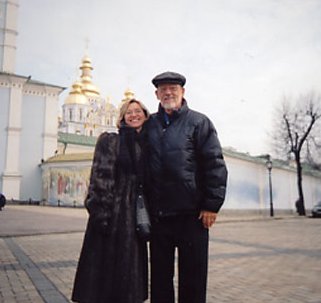
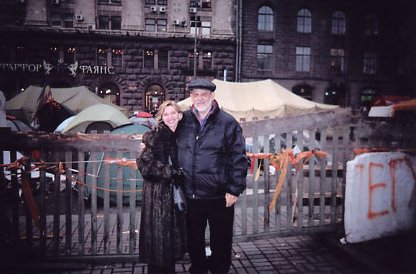
Hank and I were observers for the December 26 elections in Ukraine under the auspices of UCCA. I was an observer for the Parliamentary elections in 1991, when Ukraine was still a Soviet Socialist Republic. I was there as an observer later that year, on December 1, when the people of Ukraine went to the polls to cast their votes on a referendum of independence and to elect the country's first President, Leonid Kravchuk. I was in Kyiv to lend a helping hand when the United States opened its Embassy in 1992. Later I served as a regional director in Kyiv from 1993 to 1994 for one of the USAID assistance programs to Ukraine. I had to be there on December 26, 2004, to observe the election of the first democratic president in Ukraine, Victor Yushchenko. I was happy to have Hank also participate as an official observer. He is a non-Ukrainian but firmly supportive of his Ukrainian-born wife. Our desire to be present at the historic elections was almost thwarted by the late arrival of our visas from the Ukrainian Embassy in Washington. They finally came 24 hours before our flight to Ukraine. Our late arrival in Kyiv meant that we could not go to Kharkiv as planned, because the team of observers to that eastern Oblast had already departed. It was a disappointment. I was born south of the city and was hoping to show Hank my ancestral village.
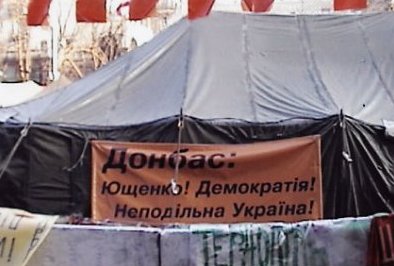
At the UCCA headquarters, located at the corner of Prorizna Street and Khryshchatyk near Independence Square, the staff reassigned us to an area close to Kyiv. Leaving the building, we had our first chance to take a closer look at the tent city clearly visible from the foot of Prorizna. It looked like a permanent encampment, with a press center, posted sentries and stoves inside the tents to keep off the bitter cold. Later that day, December 25, we celebrated my birthday with our longtime friends, the noted Ukrainian artist Oleksander Dubovyk and his wife Iryna. All in all, it was a full but happy day.
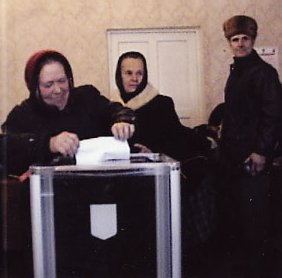
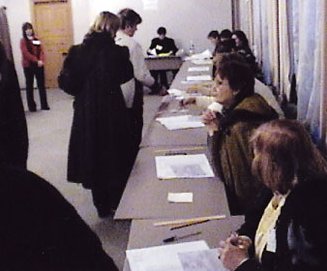
On the 26th we met our driver Aleksei, a Russian, at 6 AM in order to arrive at our first polling station in Vasyl'kiv no later than 7:15.Vasyl'kiv is a small town just outside Kyiv on the same side of the Dnipro River. We were instructed to be present before the polling station was open at 8AM to certify that the polling boxes were sealed and not tampered with before the voting started. The 16-member local election board at polling precinct #1 in the Cultural Center at Vasyl'kiv was very cooperative. The head of the board, Ol'ha Hryhorivna Blyznyuk, explained carefully every step she was taking in a procedure that was spelled out by election law. She invited us and the Ukrainian observers in the room, representing each candidate, to examine the four sealed polling boxes, the ballot forms and the pens--making sure they were not filled with disappearing ink. She also allowed us to inspect each of the six polling booths where voters would cast their ballots in secret. There were 2,318 registered voters in that precinct. Hank carried his camcorder and was able to film the entire opening of the polling station as well as the first voters to arrive.
From there we went on to other polling places in the town: to precinct # 9 located in a factory with 2236 registered voters, and precinct # 4 in a school with over 800 registered voters. We encountered no problems. Several times we found ourselves in a polling station with other international observers, from OSCE or the European Parliament. Then one or the other group would quickly leave and move on to the next precinct. There was a lot of ground to cover in one day.
Leaving Vasyl'kiv, we moved on to nearby villages in the direction of
It was the only instance of intimidation we encountered. We had more
Back in Kyiv that night, as every night since November 21, the Maidan
Towards the end of our stay I got sick with flu and was too sick to travel to Kharkiv after the elections. That trip has to wait for another day.
Katya
|

|
| For additional information, contact the Webmaster Copyright © 2026, Princeton University Class of 1957 |